 About YUU日本語
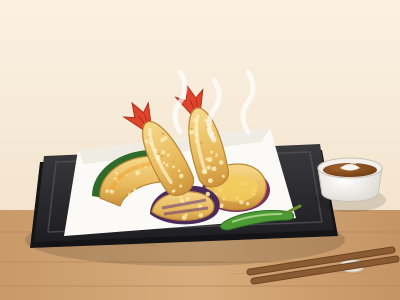
Vegetable and Shrimp Tempura
Serves 2–3 · About 50 min
Tempura of shrimp, sweet potato, eggplant, kabocha squash and shishito peppers. Even without a thermometer, you can tell the oil temperature with chopsticks and batter.
① Make the dipping sauce→② Prep the vegetables and shrimp→③ Make the batter→④ Check the oil temperature→⑤ Fry the vegetables, then the shrimp
What to buy
Fish
Vegetables
Seasonings & flour
Check what you already have
Tap an item to check it off (checks clear when you close the page).
Before frying (always, for safety)
Don't leave the stoveWhile the oil is on the heat, don't leave the kitchen, even for a moment. If you have to leave for a phone call or a visitor, always turn off the heat.
Pat everything dryIf water gets into the oil, it splatters hard. Pat the surface of the shrimp and vegetables dry with paper towels before coating them with batter.
Clear the area around the potDon't leave dish towels, paper towels or plastic wrap near the stove. Don't let the pot handle stick out past the edge of the stove.
Turn off the heat if it smokesIf white smoke comes from the oil, it's too hot. Turn off the heat right away. If the oil ever catches fire, never pour water on it. Turn off the heat and cover it with a lid bigger than the pot.
How to make it
1
Make the dipping sauce
- Put 150 ml water, 1/2 tsp dashi granules (if using homemade dashi, just 150 ml of it), 3 tbsp soy sauce and 3 tbsp mirin in a small pot
- Put on medium heat, and turn off the heat once it comes to a boil
- If using grated daikon, grate 5 cm of daikon now and lightly squeeze out the liquid
How to tell it's doneIt came to a boil and the heat is off. Leave it as is until you eat.
2
Cut the vegetables and pat them dry
- Sweet potato: with the skin on, cut into rounds (or diagonal slices) 7–8 mm thick. Soak in water for 5 minutes
- Eggplant: cut off the stem, cut in half lengthwise, then cut in half crosswise. Make shallow diagonal cuts in the skin
- Kabocha: scoop out the seeds and stringy part with a spoon, and cut into slices 7–8 mm thick
- Shishito peppers: trim a little off the stem end, and poke 1 small hole with the tip of a knife (this stops them from bursting while frying)
- Lay everything on paper towels and press more paper towels on top to soak up the water
How to tell it's doneWhen you touch the cut vegetables, your fingers don't get wet.
Be carefulIf you cut them thick, the outside burns while the inside stays hard. Cut sweet potato and kabocha thinner than 1 cm.
3
Prepare the shrimp
- Peel the shrimp. Leave the tail and the 1 section of shell next to the tail
- Bend the back slightly, poke a bamboo skewer into the middle of the back, and pull out the black vein
- Make 3–4 shallow cuts on the belly side with a knife. Then press the back with your fingers to stretch it until you hear a small "snap" (so it won't curl when fried)
- Cut the tip of the tail off at a slant, and scrape it with the back of the knife to push out the water inside (the water in the tail makes the oil splatter when frying)
- Pat the whole shrimp dry well with paper towels
How to tell it's doneThe shrimp are stretched out straight, and the surface and tails are not wet.
4
Make the batter (right before frying)
- Crack 1 egg into a measuring cup, and add cold water to make 200 ml in total (about 150 ml water). Mix well
- Pour into a bowl and add 100 g cake flour
- Mix lightly, about 10 times, with cooking chopsticks. A few lumps of flour are OK
- Put 2 tbsp cake flour for dusting on a separate small plate
How to tell it's doneWhen you lift it with chopsticks, it's loose enough to flow down slowly. You can see small bits of flour here and there.
Be carefulIf you mix too much, the batter becomes sticky and heavy when fried. Mix as little as possible.
5
Heat the oil and check the temperature
- Put vegetable oil about 3 cm deep in the pot and put it on medium heat
- After a few minutes, touch the tip of dry cooking chopsticks to the bottom of the pot and watch the bubbles from the tip
- Next, drop just 1 drop of batter from the tip of the chopsticks and see how it sinks
Bubbles when you put in the chopsticks
- Almost no bubbles → still too cool (below 150°C)
- Fine bubbles rise slowly, a few at a time → about 160°C
- Fine bubbles keep fizzing up → about 170°C (temperature for vegetables)
- Larger bubbles rush up from the whole chopstick → about 180°C (temperature for shrimp)
When you drop in 1 drop of batter
- Sinks to the bottom and takes a long time to come up → still too cool
- Sinks halfway and quickly floats back up → about 170°C
- Barely sinks and scatters on the surface → about 180°C
How to tell it's doneFine bubbles keep coming from the chopsticks, and the batter sinks halfway and quickly floats up. That's about 170°C. Start frying the vegetables.
Be carefulIf white smoke appears, the oil is too hot. Turn off the heat right away and wait for it to cool a little. The temperatures are only a guide, so use both checks.
6
Fry the vegetables
- Lightly dust the vegetables with flour and dip them in the batter
- Gently slide them in from the edge of the pot (dropping them from above makes the oil splatter)
- Put in only 3–4 pieces at a time (enough to cover about half the oil surface). Adding too many lowers the temperature
- Don't move them for 1 minute after putting them in. Then flip them once
- Lift them out with a slotted spoon and stand them up on a tray lined with paper towels to drain the oil
How to tell it's doneThe batter is light golden, the bubbles get smaller and fewer, and the sizzling sound changes to a higher, lighter crackle. A bamboo skewer goes easily through the sweet potato and kabocha.
Be carefulEggplant and shishito peppers have a lot of water and splatter easily. Move your face and hands away from the pot right after putting them in.
7
Fry the shrimp
- When the vegetables are done, scoop out the bits of batter floating in the oil with a slotted spoon
- Turn the heat up a little and bring it to about 180°C using the checks in step 5
- Hold the shrimp by the tail, dust with flour, and coat everything except the tail with batter
- Still holding the tail, gently slide it in from the edge of the pot. Only 2–3 shrimp at a time
- Flip once halfway, fry for 1 1/2–2 minutes, and lift them out
How to tell it's doneThe batter is light golden and crispy, and the bubbles get smaller and fewer. The shrimp feels firm and straight through the batter. Cut the first shrimp in the middle and check that it is white inside, not see-through (if it looks grayish and see-through, fry for 30 seconds more).
Be carefulShrimp splatter the most. Check again right before putting them in that no water is left on them.
8
Turn off the heat and serve
- When you finish frying, turn off the heat right away
- Arrange the vegetables and shrimp on plates, and serve with dipping sauce (with grated daikon if you have it) or salt
- Don't move the used oil while it's hot. Clean up only after it has cooled completely (don't pour it down the drain)
ReadyIt's crispiest right after frying. Eat it before it cools.
📚 Learn more about this dish
🥬 Ingredient guide
🔪 Cutting & cooking tips
If it didn't work out
The batter is soggy and oilyThe oil wasn't hot enough, or you put in too many at once. Next time check the temperature with the step 5 checks, and put in only 3–4 pieces.
The batter is thick and heavyYou mixed the batter too much, or used too much flour. Mix about 10 times, and let extra batter drip off before putting it in the oil.
The outside is brown but the sweet potato is hardThe slices were too thick, or the oil was too hot. Next time cut them 7–8 mm thick and fry at 170°C for 3 minutes.
The shrimp curled upThe belly cuts were too shallow, or you didn't stretch them enough. Next time make 3–4 cuts and stretch until you hear a snap.
Was this recipe helpful?
This site is free with no ads. If you like, you can support it with a tip.
☕ Send a tip Choose how many cups. Everything stays free to read.Made by YUU, a teen who loves cooking → About me