 About YUU日本語
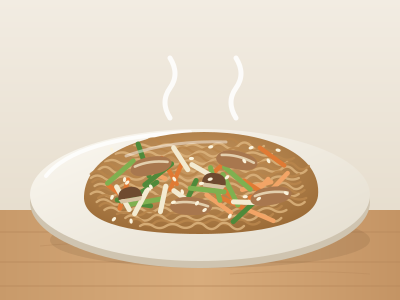
Shirataki Japchae (Konjac Noodle Stir-Fry)
Serves 2 · About 20 min
A lighter japchae made with shirataki (konjac noodles) instead of glass noodles. Dry-frying the shirataki first cooks off the water, so the sweet-salty sauce clings well. With pork in it, one plate also gives you protein.
① Cut the vegetables and pork, and mix the sauce→② Dry-fry the shirataki→③ Stir-fry the pork and vegetables→④ Add the shirataki back and coat with the sauce
What to buy
Meat
Tofu & konnyaku
Vegetables
Check you have
Tap an item to check it off (checks clear when you close the page).
🥗 What makes this diet dish work
Japchae is usually made with glass noodles. Swapping them for shirataki cuts the calories.
- The numbers: about 247 kcal and 16 g protein per person — about 200 kcal less and more protein than this site’s Japchae made with glass noodles (about 454 kcal and 10 g protein per person)
- Dry-fry the shirataki without oil: cooking off the water first keeps the sauce from getting watery, so it coats the noodles well
- Pork for protein: 150 g of thinly sliced pork goes in. It’s more filling than vegetables alone
- Sesame oil at the end too: adding 1 tsp at the end brings out the aroma. Only 2 tsp of oil in total
How to make it
1
Cut the vegetables and pork, and mix the sauce
- Slice the onion 5 mm thick. Peel the carrot and cut into thin strips 4 cm long and 3 mm wide
- Remove the seeds and stem of the pepper and cut lengthwise into 5 mm strips. Remove the shiitake stems and slice 5 mm thick
- After the vegetables, cut any large pieces of pork 2 cm wide. Wash your hands, knife and cutting board with dish soap after touching the meat
- In a small bowl, mix 1 1/2 tbsp soy sauce, 2 tsp sugar and 1/2 tsp garlic (the sauce)
How to tell it's doneEverything is cut and the sugar in the sauce has dissolved.
Be carefulDon’t touch other food with hands or tools that touched the raw pork.
2
Dry-fry the shirataki
- Drain the shirataki in a colander and cut it 3–4 times with kitchen scissors (about 10 cm long)
- Put the shirataki in a frying pan with no oil and stir with chopsticks over medium heat to cook off the water
- Move it to a plate
How to tell it's doneThe shirataki squeaks and no water is left in the pan.
Be carefulWater can spatter. Keep your face back.
3
Stir-fry the pork and vegetables
- Heat 1 tsp sesame oil in the same pan over medium, and stir-fry the pork while breaking it apart
- When the meat changes color, add the onion, carrot and shiitake and stir-fry for 2 minutes
- Add the pepper and stir-fry 1 minute more
How to tell it's doneNo pink is left anywhere on the pork. The onion is soft, and a carrot strip bends a little when you pick it up.
4
Add the shirataki back and coat with the sauce
- Put the shirataki back in, stir the sauce again and pour it around the pan
- Lift and toss everything with chopsticks until the liquid is gone
- Turn off the heat, add 1 tsp sesame oil and 1 tsp white sesame seeds, and mix. Taste it, and add soy sauce a little at a time if it’s bland
ReadyThe shirataki is browned all over and no liquid is left in the pan.
📚 Learn more about this dish
🥬 Ingredient guide
🔪 Cutting & cooking tips
If it didn't work out
It’s wateryThe shirataki wasn’t dry-fried enough in step 2. Next time, keep going until it squeaks.
The flavor didn’t soak inThe heat was turned off before the liquid was gone in step 4. Next time, keep tossing until no liquid is left.
The shirataki is too long to eat easilyCut it more times in step 2. For now, cut it on the plate with kitchen scissors.
The carrot is hardIt wasn’t stir-fried long enough in step 3. Next time, cut it thinner, or make the 2 minutes 3 minutes.
Was this recipe helpful?
This site is free with no ads. If you like, you can support it with a tip.
☕ Send a tip Choose how many cups. Everything stays free to read.Made by YUU, a teen who loves cooking → About me